July 18, 2026 · 4 min read
13 Billion Tokens In. 82 Million Out. Your AI Bill Is a Reading Problem
By Venkatesh Rao · first published on the web
Ten companies in production. And the week my GPU bill came down from $3,000 a day to $23 an hour.
Two weeks ago, aikaara became the inference layer for ten companies running AI agents in production. Real traffic. Real users. Real money on the line.
Since then I have hosted GLM-5.2 and DeepSeek Flash on B200 and B300 GPUs, run GPT-5.4 through Azure AI Foundry, and watched a single Azure deployment process 12.9 billion tokens in 72 hours.
The bills land on me now. You learn different things when the bill is yours. Here are four of them.
1. Your AI bill is an input problem, not an output problem
Three days of one deployment. 12.91 billion input tokens. 82 million output tokens. That is 157 to 1.
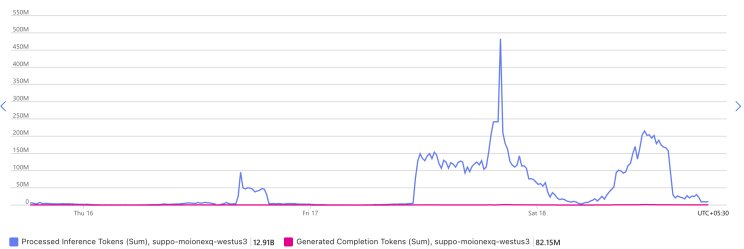
One Azure deployment over three days. Blue is the model reading. Pink is the model writing.
Most of the attention in AI goes to what models write. The completions. But a production agent barely writes. It reads. The system prompt. The tool schemas. The conversation history. The last tool result. All of it gets sent again on every turn. A 20 turn conversation re-reads its own context 20 times.
So cost and latency are dominated by prefill. The model reading, not the model generating. That one fact rewires every optimization decision.
Prompt caching stops being a nice-to-have. It becomes the biggest lever you have. Models with cheap input tokens beat smart models for most agent work, because you are paying for reading, not brilliance. And context engineering is cost engineering. Every tool schema you trim, every stale history turn you drop, is money at 157x leverage.
If your team is optimizing output tokens, they are optimizing the 82 million and ignoring the 12.91 billion.
2. Which model is best is the wrong question
The right question has three parts. Which model, for which slice of traffic, measured on which outcome.
I do not run one model. I run a portfolio. GLM-5.2, DeepSeek Flash, GPT-5.4. Traffic routes between them based on the job, and the routing changes weekly because the answer changes weekly.
I also stopped measuring models on benchmarks. I measure them on outcomes. Did the tax return get filed. Did the tool call succeed without a retry. A model that tops a leaderboard and drops 2% of tool calls in production is worse than a dumber model that never drops one.
Benchmarks are someone else's use case. Your traffic is the only benchmark that pays your bills.
3. Self-hosting does not remove the cost. It converts it.
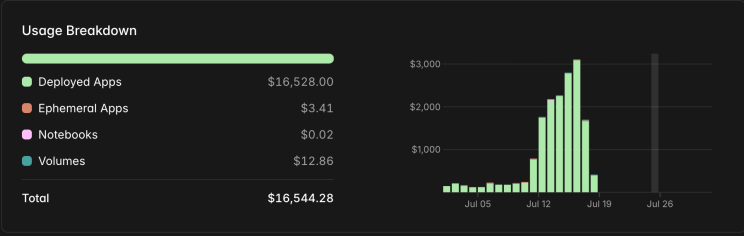
My GPU bill for July so far. The peak crossed $3,000 a day. The descent took a week of hardening.
$16,544 this month. At the peak the GPUs were burning more than $3,000 a day. Today DeepSeek Flash serves production traffic at $23 an hour.
I want to keep that number honest. $23 an hour around the clock is about $550 a day. The real comparison is $550 against $3,000. Call it 5x, not a miracle.
And the $23 was not bought. It was earned over a week of unglamorous work. Catching dropped tool calls. Handling junk completions. Writing retry logic. Keeping expensive GPUs busy, because an idle B200 bleeds money whether it serves one request or none.
The trade is simple to state. Self-hosting swaps an API invoice for an engineering discipline. Above a certain volume, when you control your own routing, your own reliability, and your own data, that trade is worth it. Below that volume, you are buying yourself a second job. Know which side of the line you are on before you order GPUs.
4. Inference cost is a curve you bend, not a price you accept
The bill did not fall because I found a magic cheaper model. It fell because I treated tokens the way finance teams treat cloud spend. Watch the curve every week. Bend it on purpose.
Look at the July chart again. A ramp to $3,000 a day, then a walk down. The descent is the actual work. Routing. Caching. Utilization. Context cuts. None of it is a one time decision. AI cost behaves like cloud cost. Ignore it and it compounds against you. Manage it and it compounds for you.
The takeaway
The model is not the moat. The stack is.
Anyone can call an API. The companies that survive their own success have operational muscle underneath: routing, caching, hardening, cost control, and quality measured on outcomes that pay them instead of benchmarks that flatter a vendor.
So the question for your team is not whether you are on the best model. It is who owns your inference economics, and whether they are looking at the right 12.91 billion tokens.
At scale, that is not an infrastructure detail. That is the business.
One question before I go. If you run agents in production, what is your input to output token ratio? Mine is 157 to 1. Reply or comment with yours. I want to see the spread.
See you next week.
Apologies to have missed sending this last week. Got caught into model experiments. Will be sending this on Saturdays going forward.